

Weld Neck (WN) vs. Slip-On (SO) Flange: A Comprehensive Technical Reference
1. Introduction In the complex landscape of PVF (Pipes, Valves, Flanges) procurement, selecting the correct flange type is critical for both operational safety and cost efficiency. The Weld Neck (WN) and Slip-On (SO) flanges are the two most prevalent designs in global infrastructure. This technical reference clarifies their structural differences, welding requirements, and standard applications according to ASME B16.5 and EN 1092-1.
2. Anatomical and Structural Comparison
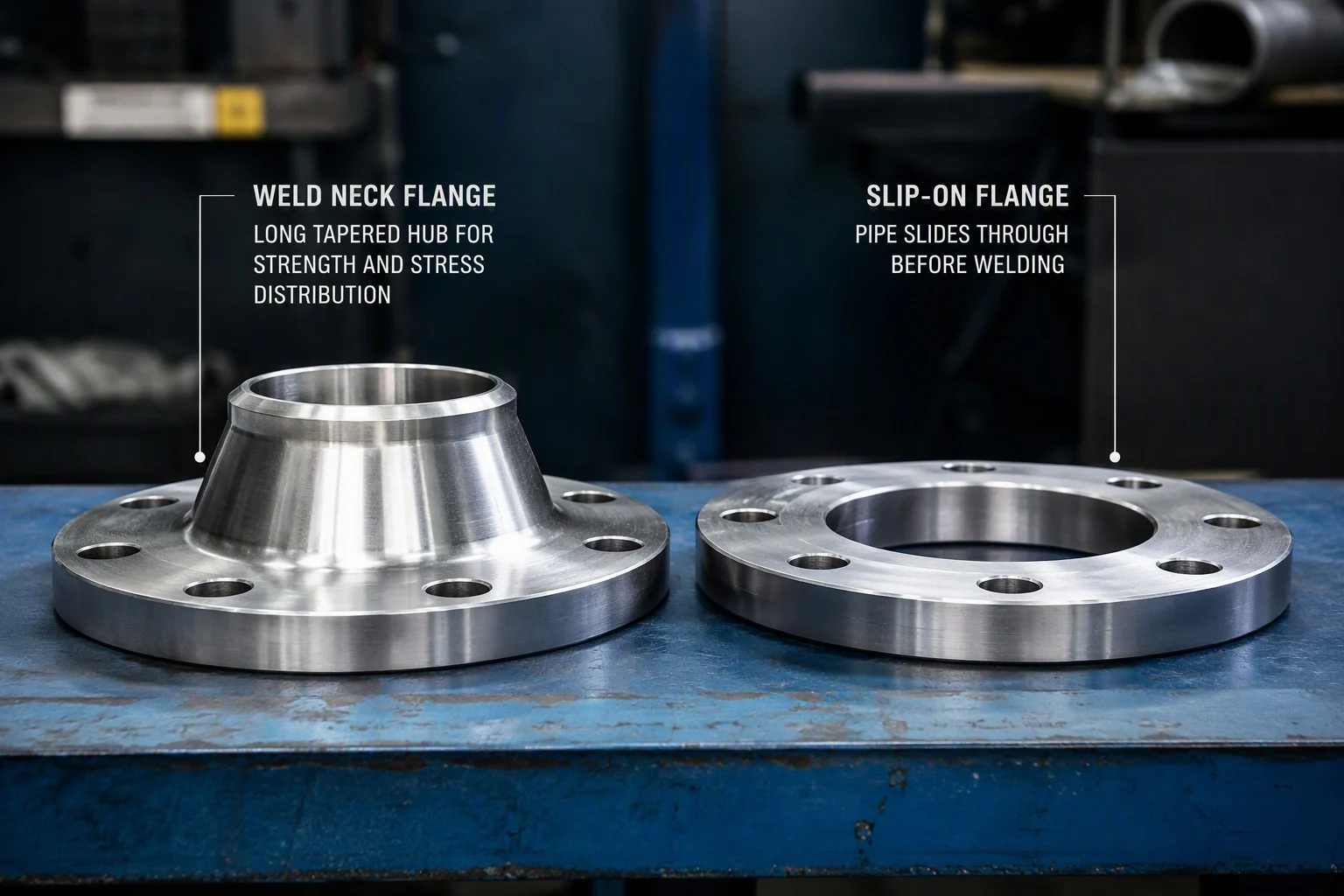
- Weld Neck Flange (WN): Distinguished by a long, tapered hub that transitions gradually into the pipe. The bore of the flange is machined to match the inside diameter (ID) of the mating pipe, ensuring a smooth flow with minimal turbulence.
- Slip-On Flange (SO): A ring-like design where the inside diameter is slightly larger than the pipe’s outside diameter (OD). The pipe is inserted into the flange and secured with internal and external welds.
3. Welding and NDT (Non-Destructive Testing)
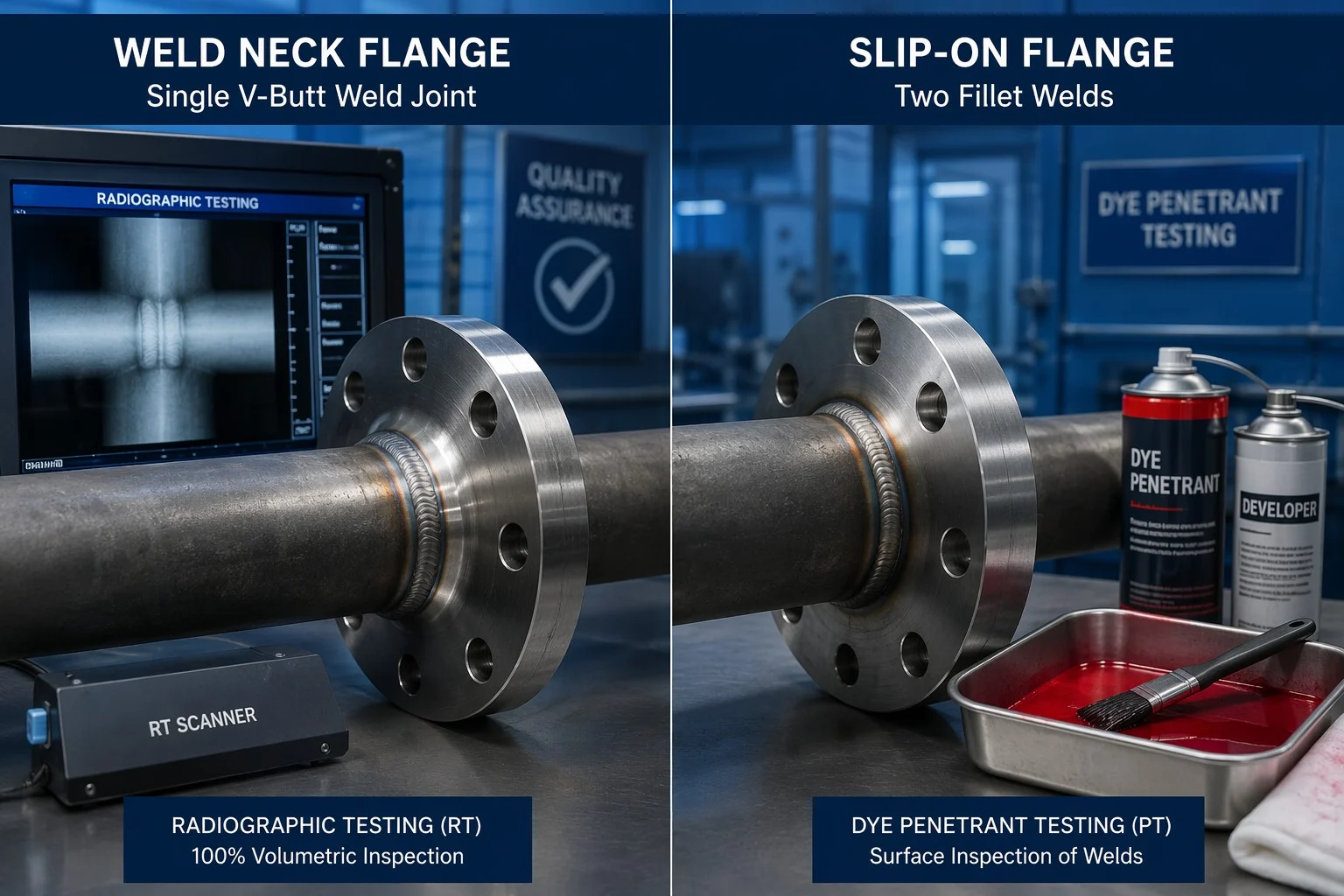
- WN Welding: Requires a single V-butt weld at the hub-to-pipe junction. This type of joint allows for 100% Radiographic Testing (RT), providing full volumetric verification of the weld integrity.
- SO Welding: Requires two fillet welds—one external at the back of the flange and one internal near the face. Due to the overlapping geometry, fillet welds can typically only be inspected via Surface NDT (Dye Penetrant or Magnetic Particle), which does not reveal internal weld defects.
4. Pressure and Temperature Ratings While both types are available in Class 150 to Class 2500, their performance under stress varies:
- WN: Superior at handling high-pressure surges and extreme temperature fluctuations (Cryogenic to High-Temp).
- SO: Generally limited to Class 150 and Class 300 applications in non-critical utility lines.

Related Articles
-
 July 29,2026
Welding vs. Grooving: Why Modern Commercial Projects are Switching to DTC Grooved Systems
The Labor Cost Revolution In the US and European commercial construction markets, labor is the single highest expense. Welding a 6-inch fire main requires a skilled welder, fire permits, and significant time. 1. 3x Faster Installation A DTC grooved system can be installed 3 to 4 times faster than a …
-
 July 29,2026
An Introduction to Grooved Piping Systems: Speed, Flexibility, and Vibration Dampening
1. The Grooved Concept Instead of welding or threading, a groove is rolled or cut into the end of the pipe. A Grooved Coupling (containing a C-shaped gasket) is then bolted over the two pipe ends to create a seal. 2. Rigid vs. Flexible Couplings Rigid Couplings: Create a joint that behaves like a we …
-
 July 29,2026
Avoiding the “Paperwork Trap”: Why DTC Conducts Independent PMI and Hardness Testing
The Risk of Document Fraud In the global PVF market, a certificate is only as good as the company behind it. Unfortunately, “paperwork-only” suppliers often pass off inferior materials with forged MTCs. 1. Positive Material Identification (PMI) At DTC, we don’t just trust the mill; …